What CSRD Means for Mid-Sized Manufacturers in 2026
A practical guide to CSRD obligations for mid-sized European manufacturers: what is required, what is in scope, and what needs to be in place before the first reporting deadline.
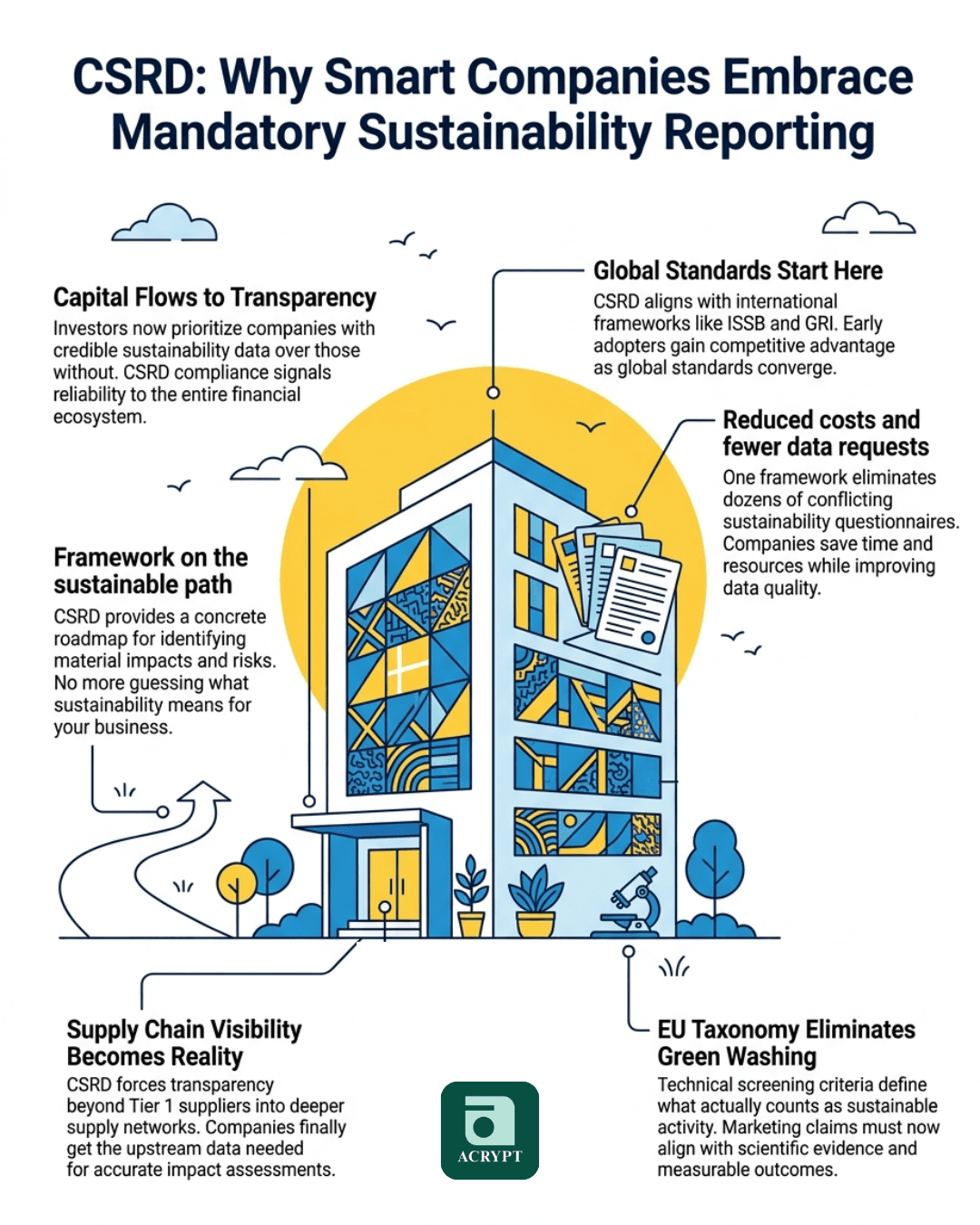
Who is in scope
The Corporate Sustainability Reporting Directive (CSRD) applies across the EU in phases. Large companies (more than 500 employees) have been in scope since financial year 2024. Mid-sized companies enter the obligation in financial year 2025, with the first sustainability report due in 2026.
A company is considered mid-sized under CSRD if it meets at least two of the following three thresholds:
Non-EU companies with significant EU operations (net turnover above €150 million within the EU and at least one EU subsidiary or branch above the relevant thresholds) are also in scope from 2028.
What the report must contain
CSRD reports must follow the European Sustainability Reporting Standards (ESRS). These are mandatory templates covering environment, social, and governance topics. Not all ESRS topics apply to every company: the starting point is a double materiality assessment, which determines which topics are relevant enough to require disclosure.
For manufacturers, the most commonly material ESRS topics are climate change (ESRS E1), pollution (ESRS E2), resource use and circular economy (ESRS E5), and own workforce (ESRS S1). A company with significant supply chain exposure will also typically need to address ESRS S2 (workers in the value chain).
Key steps before the 2026 deadline
- 01Confirm your in-scope statusCheck the two-out-of-three threshold test against your 2024 and 2025 accounts. Some companies near the boundary may need legal advice on the correct assessment date.
- 02Conduct a double materiality assessmentThis is the mandatory first step under ESRS. It identifies which sustainability topics are material from an impact perspective (your effects on people and the environment) and from a financial perspective (risks and opportunities that affect your business). The methodology and stakeholder process must be documented.
- 03Map your data gapsOnce material topics are identified, review what data you currently collect and what is missing. ESRS E1 (climate) requires Scope 1, 2, and 3 GHG emissions. Many manufacturers have Scope 1 and 2 but lack Scope 3 coverage, particularly for purchased goods and logistics.
- 04Establish data collection processesCSRD data must be verifiable. Sustainability disclosures will be subject to limited third-party assurance in 2026, moving to reasonable assurance in later years. Your data collection, calculation methods, and assumptions need to be auditable.
- 05Integrate into the management reportUnder CSRD, the sustainability report is part of the statutory management report, not a standalone document. It must be filed with the relevant national registry and tagged in XBRL/iXBRL format.
Where LCA and EPDs fit in
ESRS E1 requires disclosure of GHG emissions across the full value chain (Scope 1, 2, and 3). For manufacturers, Scope 3 category 1 (purchased goods and services) is typically the largest contributor and the hardest to quantify. A Life Cycle Assessment (LCA) provides the methodological backbone for calculating these upstream emissions in a way that is ISO-compliant and audit-ready.
Environmental Product Declarations (EPDs) serve a complementary function: they provide third-party verified, product-level environmental data that can be used in procurement decisions and passed upstream in the value chain. As CSRD obligations cascade down to suppliers through large customers' Scope 3 reporting, having a verified EPD becomes a procurement requirement rather than a voluntary credential.
ESRS E5 (resource use and circular economy) also connects directly to LCA methodology, requiring disclosure on material flows, waste, and circularity metrics that an LCA study can directly support.
Common misconceptions
Even companies below the CSRD thresholds will face indirect pressure. Large in-scope customers are required to report Scope 3 emissions, which means they will request emissions data from their suppliers. CSRD obligations cascade through supply chains regardless of whether the supplier is directly in scope.
Existing voluntary CSR reports do not satisfy CSRD. The ESRS require a specific structure, defined data points, and third-party assurance. A gap assessment against ESRS is needed before the existing report can be mapped to the new requirements.
CSRD requires operational data (energy, emissions, waste, water), value chain mapping, and stakeholder engagement. It cuts across procurement, operations, HR, and finance. Starting with only the finance team is a common setup failure.
Key dates
- FY 2024Large companies (500+ employees) in scope. First reports due in 2025.
- FY 2025Mid-sized companies (250+ employees or €50M+ turnover) in scope. First reports due in 2026.
- FY 2026Listed SMEs in scope (with opt-out possibility until 2028).
- FY 2028Non-EU companies with significant EU operations in scope.
Preparing for your first CSRD report?
Acrypt delivers CSRD compliance packages for mid-sized manufacturers: double materiality assessment, ESRS gap analysis, GHG inventory, and audit-ready documentation.
Book a free consultation